
Title: Engineered Metarhizium fungi produce longifolene to attract and kill mosquitoes
Dan Tang, Jiani Chen, Yubo Zhang, Xingyuan Tang, Xinmiao Wang, Chaonan Yu, Xianxian Cheng, Junwei Zhang, Wenqi Shi, Qing Zhen, Shuxing Liu, Yizhou Huang, Jiali Ning, Guoding Zhu, Meichun Zhang, Juping Hu, Etienne Bilgo, Abdoulaye Diabate, Sheng-Hua Ying, Jun Cao, Raymond J St Leger, Jianhua Huang, Weiguo Fang
Abstract
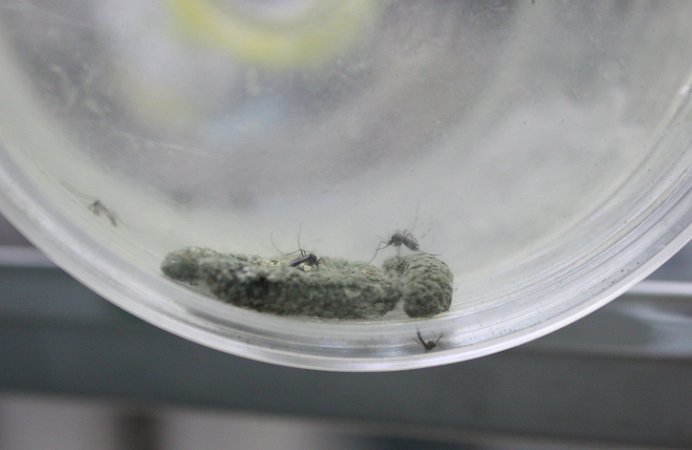
Chemical insecticides have been the primary method of mosquito control, but in recent years, mosquitoes have become resistant to these compounds. Metarhizium fungi are emerging as promising alternatives and can kill mosquitoes with a small number of spores. It was previously shown that caterpillars affected by fungal infections can attract mosquitoes. However, the mechanisms and potential applications of this attraction are lacking. Here we show that Metarhizium-colonized insect cadavers release the volatile longifolene to attract and infect healthy insects, facilitating spore dispersal. We identified the responsible odorant receptors in Drosophila melanogaster and Aedes albopictus. The virulent mosquito pathogen Metarhizium pingshaense was engineered to express pine longifolene synthase to produce a large amount of longifolene on media. The transgenic spores effectively attracted and killed male and female A. albopictus, Anopheles sinensis and Culex pipiens. Attraction of wild-caught mosquitoes was not impacted by human presence, but mosquito-attracting flowering plants competed with transgenic M. pingshaense for attractiveness, although mortality remained over 90%. This study uncovered an active spore dispersal mechanism in broad-host-range entomopathogenic Metarhizium, enhancing mosquito control efficacy.
Link: https://www.nature.com/articles/s41564-025-02155-9