
Title: Mechanisms underlying the sustainability of yields and soil nitrogen in the rice-fish system
Lufeng Zhao , Liang Guo , Liangliang Hu , Taojie Zhang , Ranxin Dai , Zijun Ji , Junlong Ye , Lei He , Jianjun Tang , Jiaen Zhang , Xin Chen
Abstract
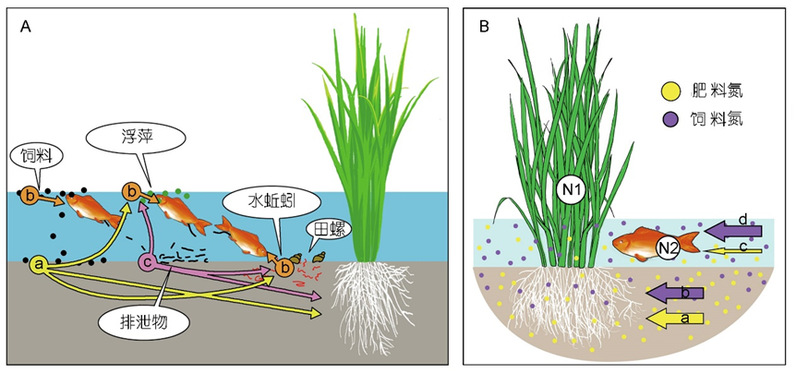
The practice of raising cyprinid fish alongside rice in paddy fields (i.e., the rice-fish coculture system) has a long history in China and has contributed to sustainable local food production. With the development of modern intensive agriculture, a key challenge is how to improve fish yields in traditional rice-fish coculture systems without compromising rice productivity and causing negative environmental impacts. In this study, we conducted regional-scale farm and field surveys, and a long-term field experiment to evaluate rice yields, fertilizer-nitrogen (N) use, soil organic carbon (C) content, and soil total N levels under rice-fish coculture systems with various fish yield levels. Using the δ15N stable isotope method, we designed a micro-plot field experiment to assess how fertilizer-N and fish feed-N are recycled and utilized by rice, fish, and associated organisms within the rice paddy ecosystem. The regional-scale farm survey revealed that rice yields in rice-fish coculture systems with three distinct fish yield levels (<0.5, 0.50–1.0,>1.0 t hm–2) showed no significant difference compared to the average rice yields from local monoculture rice farms. Paired comparisons of rice monoculture and rice-fish coculture systems demonstrated that rice-fish cocultures achieved an average fish yield of 0.99±0.07 t hm–2, while maintaining rice yields comparable to those of corresponding rice monoculture systems. Rice-fish cocultures exhibited a significant reduction of fertilizer-N inputs while maintaining significantly higher soil organic C and total N contents compared to rice monoculture systems. The long-term field experiment demonstrated that rice-fish coculture systems achieving fish yields of 0.75 t hm–2 and 1.5t hm–2 produced significantly higher rice yields compared to both rice monocultures and rice-fish cocultures with lower fish yields (about 0.3 t hm–2). Furthermore, in rice-fish cocultures with a target fish yield of 1.5t hm–2 and fish-feed supply of 2.54 t hm–2, rice productivity and soil total N remained stable even when fertilizer-N application was reduced by 20%. The stable isotope δ15N tracer experiment showed that fish utilized 0.29% of the fertilizer-15N, while rice utilized 10.54% of the feed-15N. A diet analysis of the fish based on stable isotopes δ13C and δ15N further revealed that 46.68% of the fish’s food sources originated from the paddy field, even though fish feed was supplied. The fish foraged on and transformed the nitrogen (N) from the supplied feed and natural food resources. A portion of the N from these food sources was released by the fish into the paddy fields, where it was utilized by rice plants and other organisms. Thus, N in the paddy ecosystem can be used complementary by rice and fish. The stable isotope δ15N tracer experiment also showed that 72.12% of feed-15N remained in the rice field at harvest, indicating potential risk of non-point source pollution arising from rice-fish coculture. Our results suggest that understanding how the rice-fish coculture system performs guide strategies to improve the sustainability of this system.
Link:https://www.sciengine.com/CSB/doi/10.1360/TB-2024-1319