
Title: Host-mediated selection drives sexual dimorphism of microbiota assembly in the dioecious living fossil Ginkgo biloba
ChenFeng Lin, JunJie Wu, YunPeng Zhao
Abstract
Dioecious plants harbor sexually dimorphic microbiota that enhance their reproductive success. However, the spatial and temporal patterns, particularly the ecological processes underlying the sexual dimorphism of plant microbiota assembly, remain largely unknown.
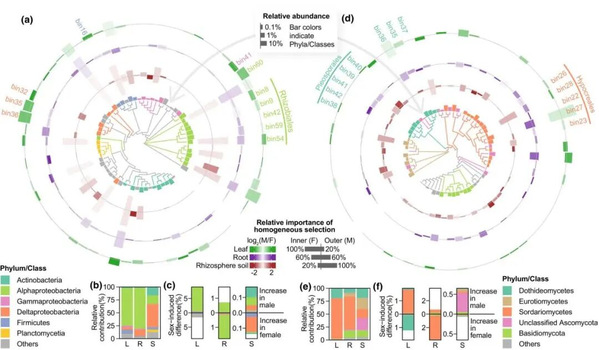
We investigated the bacterial and fungal communities in 180 samples collected from male and female trees of Ginkgo biloba across three niches and three developmental stages, quantifying the relative importance of host-mediated selection to assess the role of host sex in microbiota assembly.
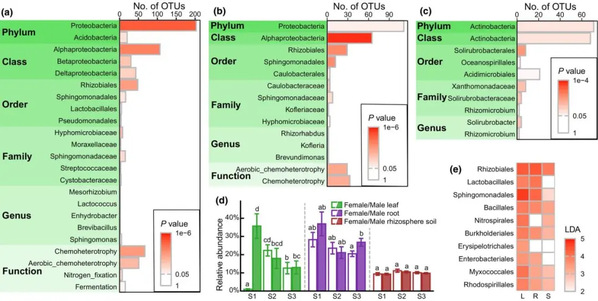
Our results revealed significant filtering of ginkgo microbiota along the soil–root–leaf continuum, as well as dynamic shifts throughout the annual growth cycle of the host. Male and female hosts exerted differential selection on specific microbial taxa, leading to sexually dimorphic microbiota compositions with spatiotemporal variations. Chemoheterotrophic bacteria were enriched in male leaves during the flowering stage, whereas pathogenic and saprotrophic fungi were depleted in female trees during the seed set stage.
Host-mediated selection on specific microbial functional groups drives the sexual dimorphism of microbiota assembly, aligning with sex-specific reproductive and adaptive strategies. Our findings reveal a dynamic connection between plant sex and microbiota function in long-lived woody plants, and lay a foundation for future microbiome-assisted conservation of dioecious species.
Link: https://doi.org/10.1111/nph.70591