
Title: A durable hydrogel-encapsulated biohybrid for sustainable triclosan bioremediation
Yiran Yin, Hao Ren, Yaxuan Wu, Jia Cheng, Yong Qin, Weixiang Wu, Hongzhi Tang, Christopher E. French, and Zhenmei Lv
Abstract
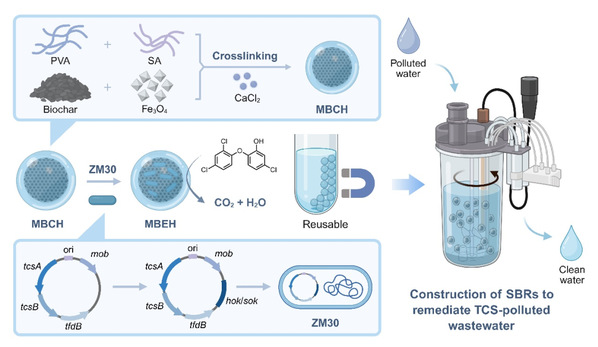
Synthetic biology provides an effective approach for emerging contaminant degradation, but biosafety and stability challenges limit its practical use. Here, we engineered Pseudomonas knackmussii ZM30 for efficient triclosan (TCS) degradation, incorporating the hok/sok system to ensure plasmid stability without antibiotics. To enhance applicability, we developed MBEH: a magnetic biochar-based engineered bacteria composite in hydrogel. MBEH synergistically adsorbs TCS (via biochar) and degrades it (via ZM30), reducing secondary pollution. In sequencing batch reactors, MBEH achieved stable TCS removal with minimal disruption to activated sludge microbiota. No ZM30 was detected in effluent, confirming its biosafety. MBEH exhibited 80.52% recovery from sludge and 1.98 × 10⁶colony-forming units (CFU)/g bacterial viability after 40 days of operation, ~95% of the initial level. This strain–material hybrid combines targeted degradation with environmental resilience, offering a scalable strategy for TCS bioremediation. The design principle is adaptable to other pollutants, bridging synthetic biology and practical environmental applications.
Link: https://www.cell.com/trends/biotechnology/fulltext/S0167-7799(25)00414-7