

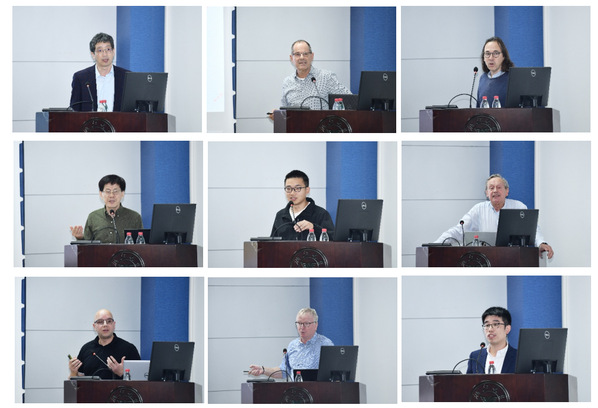
On November 3, 2025, the College of Life Sciences at Zhejiang University hosted an international workshop on the molecular and genetic mechanisms of plant environmental resilience. Chaired by Prof. Shaojian Zheng, the full-day program in Room 245 gathered leading researchers to discuss new insights into nutrient signaling, chromatin regulation, and stress-response pathways in plants.
Prof. Steffen Abel (Martin Luther University Halle-Wittenberg & the Leibniz Institute of Plant Biochemistry) opened with “Phosphate–Metal Interactions Govern Root Development.” He presented a Pi–Fe redox model centered on LPR1–PDR2: LPR1, a cell-wall multicopper oxidase, converts Fe² to Fe³, generating ROS and callose that transiently close plasmodesmata and slow meristem growth when Pi is scarce; PDR2, the ER P5A-ATPase, restrains this pathway via ER quality control. Evidence from homology, mutagenesis, and natural variants points to an acidic Fe-binding pocket and an ancient, adjustable module linking Pi status to apoplastic iron chemistry and root resilience.
Prof. Florian Frugier (Institute of Plant Sciences Paris-Saclay, CNRS) followed with “Local and Systemic Regulation of Legume Adaptation to Nitrogen-Deficit Stress.” Using Medicago as a model, he showed that the CEP/CEPD–CRA2 pathway systemically promotes nodulation under low nitrogen—and even under elevated CO₂—while CLE peptides acting through SUNN impose autoregulation of nodulation when nitrate is sufficient. A central miR2111–TML hub tunes root competence, and early dialogues (flavonoids↔Nod factors; strigolactones↔Myc factors) coordinate nodulation and arbuscular mycorrhization, pointing to strategies to improve nitrogen-use efficiency with less fertilizer.
Guohua Xu (Nanjing Agricultural University) showed how nitrogen programs rice yield by coordinating developmental timing, stem mechanics, and source–sink transport. On development, Nhd1 and HRN1 modulate heading and internode elongation; HRN1 feeds into lignin and GA pathways, and editing promoter SNP-191 shifts low-N resilience between sd1 and SD1 backgrounds, offering a breeding lever. On transport, STP28 is a tiller-bud high-affinity glucose importer repressed by glutamine; acting upstream of GA2-oxidases, it couples sugar influx to tillering. Loss-of-function stp28 alleles increase panicles and grain yield across N regimes, improving productivity with lower N.
Zhongjie Ding (Zhejiang University) showed how roots sense aluminum and launch rapid defenses in acidic soils. He presented an ALR1–BAK1 receptor model in which the ALR1 cytosolic domain directly binds Al³⁺, triggering RbohD-dependent ROS that promote STOP1 accumulation by inhibiting RAE1-mediated proteolysis, thereby inducing ALMT1/MATE for organic-acid efflux. A phospho-switch at ALR1 S696/S698 tunes the pathway: PP2CH1/2 dephosphorylate to enhance complex assembly and signaling, while PBL27 re-phosphorylates to dampen it. This framework links Al perception to flux control and transcriptional defense, highlighting tractable targets for breeding aluminum-resilient crops.
Translated by GAO xufan