
Title: Insect herbivores and soil fertility drive variation in density-dependent seedling dynamics across a fragmented landscape
Yanping Lei, Robert Bagchi, Jinliang Liu, Zhonghan Wang, Jirui Wang, Guang Hu, Mingjian Yu*
Abstract
Habitat fragmentation is associated with decreased species diversity. However, the effects of fragmentation on the processes that maintain diversity, such as enemy-mediated negative conspecific density dependence (CDD), are largely unknown. We examined how negative CDD in seedling survival is influenced by habitat fragmentation.
We measured the effect of conspecific density on seedling survival of 30 species for 10 years on 25 islands in an artificially fragmented habitat and took parallel measurements of the potential drivers: soil physical and chemical properties, and insect herbivore communities.
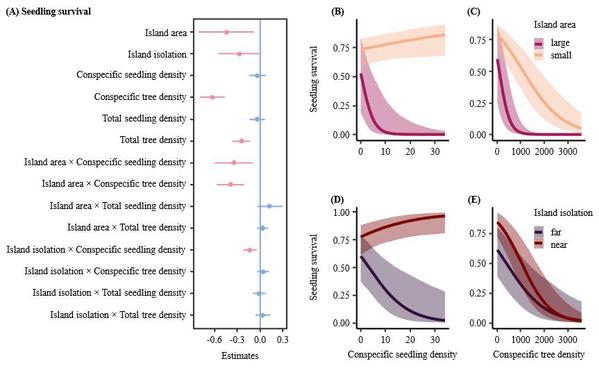
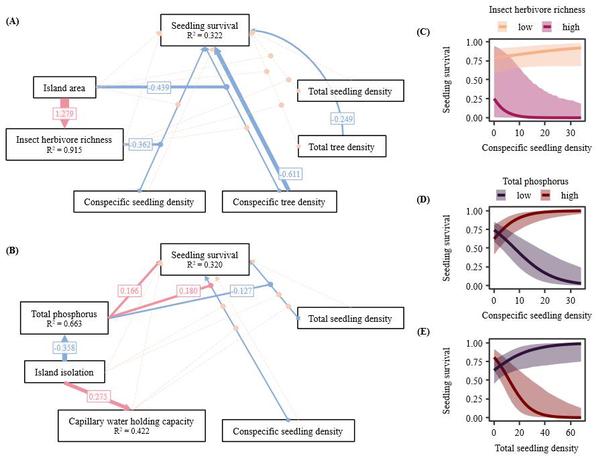
Increasing densities of conspecific trees and seedlings reduced seedling survival more on larger and more isolated islands. These processes were linked to increases in insect herbivore richness on larger islands, and less fertile soils on more isolated islands.
Synthesis. Our results indicate that shifts in the abiotic and biotic conditions of fragmented habitats can modify the mechanisms thought to maintain species coexistence, perhaps contributing to the long-term decay of fragmented ecosystems, and suggesting approaches for restoration. The relationships between island configuration, and insect herbivore communities and soil properties may vary among ecosystems, which could help explain variation among studies in the effects of fragmentation on biodiversity.
Link:https://besjournals.onlinelibrary.wiley.com/doi/10.1111/1365-2745.70117