
Title: H2O2-mediated oxidation of PHOSPHATE STARVATION RESPONSE2 promotes adaptation to low phosphate in rice
Funing Meng,Dan Xiang,Ziqi Bu,Rongbin Lin,Xinyang Sun,Jiming Xu,Yunrong Wu,Yu Liu,Zhongchang Wu,Xiaorong Mo,Javier Paz-Ares & Chuanzao Mao
Abstract
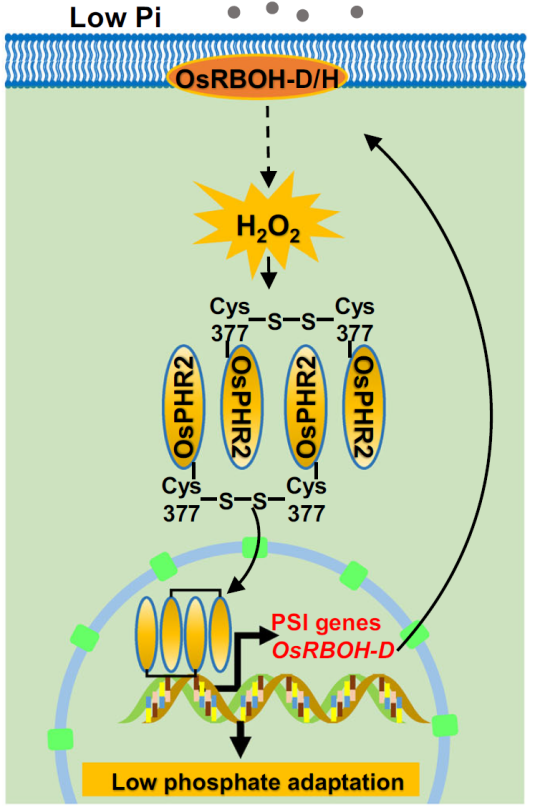
Phosphorus (P) is an essential macro-nutrient for plant growth and development. It is preferentially taken as inorganic phosphate (Pi). Plants have evolved elaborate mechanisms to adapt to low Pi (LP) stress through activating Pi-starvation responses. H2O2 is an important signal molecule involved in plant adaptation to diverse environmental stresses. However, whether H2O2 plays a role in Pi-starvation responses remains unknown. Here, we reveal that H2O2 produced by the respiratory burst oxidase homologs OsRBOH-D/H facilitates phosphate uptake and utilization under LP conditions in rice. Mechanistically LP-induced H2O2 promotes the oxidization of the key phosphate signaling transcription factor PHOSPHATE STARVATION RESPONSE2 (OsPHR2) at its Cys377 residue to trigger its oligomerization, sequence-specific DNA binding ability, and nuclear translocation, thereby activating Pi-starvation responses to adapt to LP conditions. Additionally, our molecular and biochemical data revealed that OsRBOH-D is a direct target gene of OsPHR2. Thus, OsPHR2 and OsRBOH-D form a positive feedback regulatory loop in which H2O2 acts as a second messenger to amplify the Pi-starvation response.
Link:https://www.nature.com/articles/s41467-025-63841-0