
Title:Interconnecting fragmented forests: small and mobile birds are cornerstones in the plant-frugivore meta-network
Chen Zhu, Bo Dalsgaard, Wande Li, Christopher N Kaiser-Bunbury, Benno I Simmons, Peng Ren, Yuhao Zhao, Di Zeng, Fernando Gonçalves, Xue Zhang, Longxiao Chang , Ping Ding, Xingfeng Si
Abstract
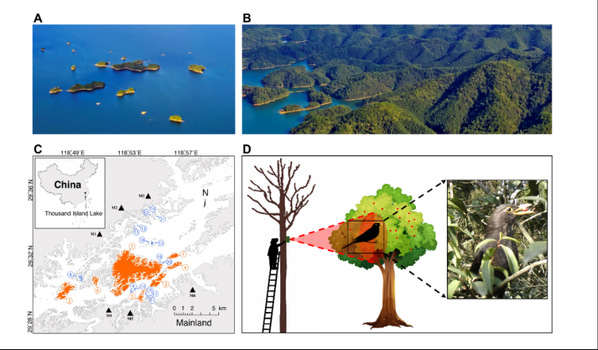
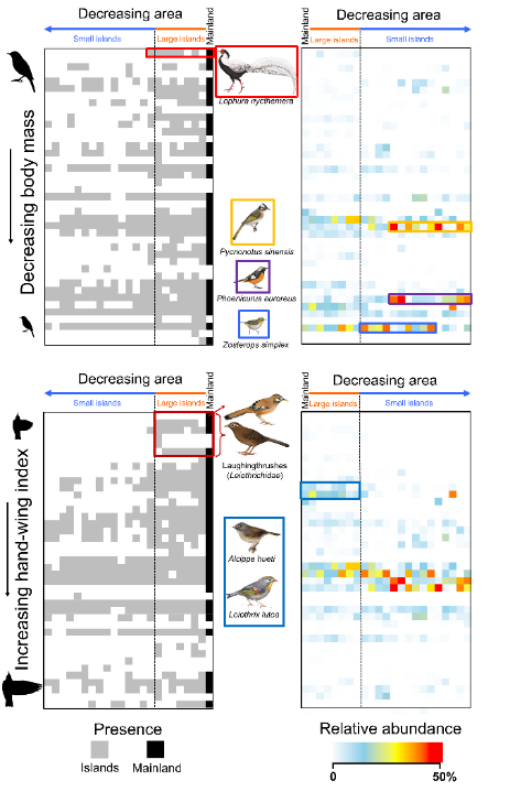
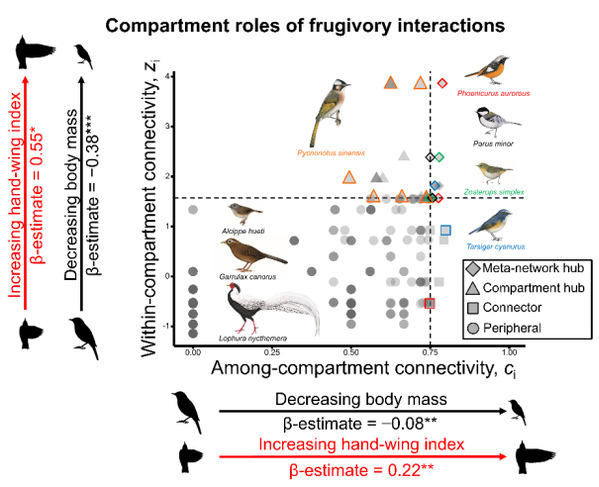
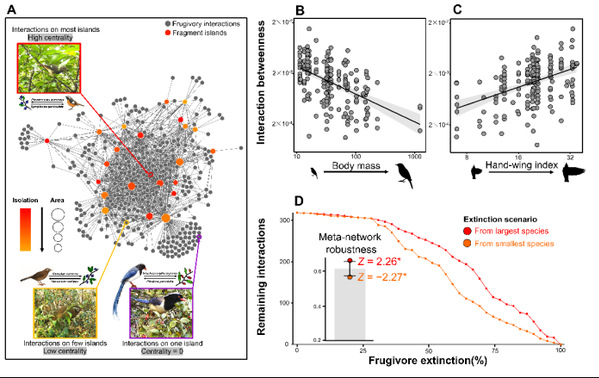
This study investigated avian frugivory networks on land-bridge islands and adjacent mainland sites in Zhejiang's Thousand Island Lake (Figure 1), examining how bird body size and dispersal capacity influence island bird community composition (Figure 2) and species centrality within interaction networks (Figures 3, 4). The research revealed that small-bodied birds with strong dispersal abilities dominate frugivorous interactions and seed dispersal processes on islands, suggesting these species may act as potential functional connectors in fragmented forests. The study recommends prioritizing the conservation of large habitat patches to maintain biodiversity and ensure long-term stability of ecosystem functions in fragmented landscapes. Simultaneously, smaller patches should be utilized as stepping stones to facilitate frugivore movement, enabling the functional integration of isolated patches into continuous habitats through animal-mediated dispersal. Furthermore, the findings indicate that the critical contribution of some common species to sustainable forest regeneration has been underestimated. Against the backdrop of irreversible human-induced habitat fragmentation and conventional conservation strategies predominantly focused on high extinction-risk species, this research emphasizes the need to recognize these functionally important common species for ecosystem sustainability, thereby optimizing conservation strategies to achieve long-term healthy ecosystem development.
Link: https://www.pnas.org/doi/10.1073/pnas.2415846122