
Title: PHR-Mediated Pi Starvation Response Mobile Messenger RNAs Represent Noncoding Transcripts in Recipient Tissues
Weiguo Dong, Shuman Wang, Chao Liu, Lulu Qiao, Kai Liu, Qiongli Jin, Xiaorong Mo, Xingxing Shen, Keke Yi, Zhiye Wang*
Abstract
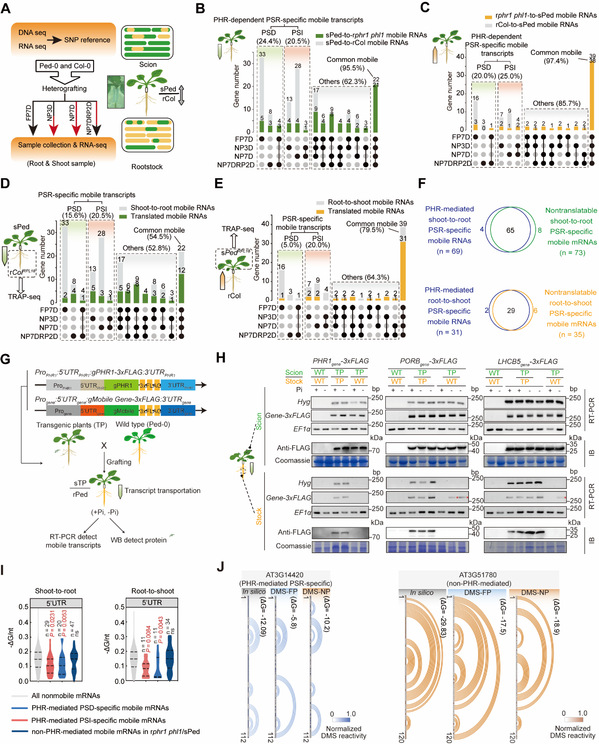
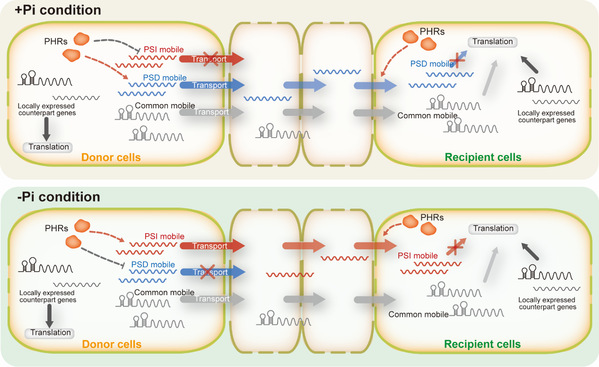
Nutritional deficiency for phosphate (Pi) or nitrogen triggers long-distance transport of specific mobile mRNAs, but little is known about the underlying regulation, function, and structural features of these mobile nutrient starvation-specific mRNAs. Here, heterografting and high-throughput sequencing are used to explore the landscape of long-distance mRNA transport in Arabidopsis under normal and Pi-starvation conditions. Hundreds of Pi starvation response (PSR)–specific mobile mRNAs are discovered, although their abundance is constant between normal and Pi starvation conditions. The mobility of these PSR-specific mobile mRNAs is largely dependent on PHOSPHATE STARVATION RESPONSE (PHR) function, based on mutant analysis. Notably, translatome analysis and transgenic experiments reveal that these PHR-mediated PSR-specific mobile mRNAs are translated in donor tissues, but not in recipient tissues. Further, these mobile mRNAs harbored a more unfolded 5′ UTR than nonmobile mRNAs, non-PSR-mobile mRNAs, and nitrogen starvation–response mobile mRNAs. The study reveals that these PSR-specific mobile mRNAs are transported to recipient tissues to carry out a function independently of their encoded protein.
Link:https://advanced.onlinelibrary.wiley.com/doi/10.1002/advs.202502911