
Title: OsSEC3A, a key exocyst subunit, is required for the emergence of crown root in rice
Jianshu Zhu, Mengzhen Li, Mengxiao Zhao, Yuelin Luo, Meiyan Ren, Keju Zhao, Jiming Xu, Yunrong Wu, Yu Liu, Zhongchang Wu, Xiaorong Mo, Chuanzao Mao
Abstract
· Crown root (CR) is the main component of the fibrous root system. However, the molecular regulatory mechanism of CR development remains unclear.
· Here, we identified two allelic crown root defect mutants, named crd2-1 and crd2-2, from an independent ethyl methane sulfonate-mutagenized mutant library. Cytological analysis revealed that the CR primordia (CRP) of crd2 were aborted and vacuolated at the stages from establishment to emergence. The causal gene of crd2 was cloned through map-based cloning, which encodes an annotated key exocyst subunit OsSEC3A, and was confirmed by genetic complementation assay and CRISPR/Cas9-mediated mutation analysis.
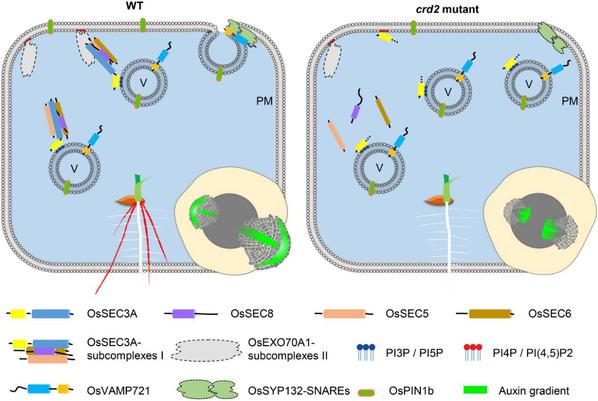
· OsSEC3A is highly expressed at the stem base, and its protein has specific phosphatidylinositol monophosphate binding capacity. Co-localization analyses and in vivo IP-LC-MS/MS experiments revealed that OsSEC3A is present on OsVAMP721 vesicles, where it forms a pre-assembled heterotetrameric subcomplex together with OsSEC5, OsSEC6, and OsSEC8. We demonstrated that the plasma membrane localization of OsSEC3A depends on its direct interaction with OsEXO70A1. Mutations in OsSEC3A severely disrupted OsPIN1b localization and auxin gradient distribution in the CRP cells.
· These results expanded our understanding of exocyst assembly and its association with CR development in rice (Oryza sativa), which will benefit the root genetic improvement for high-yield and nutrient-efficient crops.
Link:https://nph.onlinelibrary.wiley.com/doi/10.1111/nph.70696