
Title: Triclosan induced restructuring of microbial communities and antibiotic resistance gene dynamics in activated sludge: Insights and mitigation strategies
Yiran Yin, Hao Wu, Christopher E. French, Zhenmei Lu
Abstract
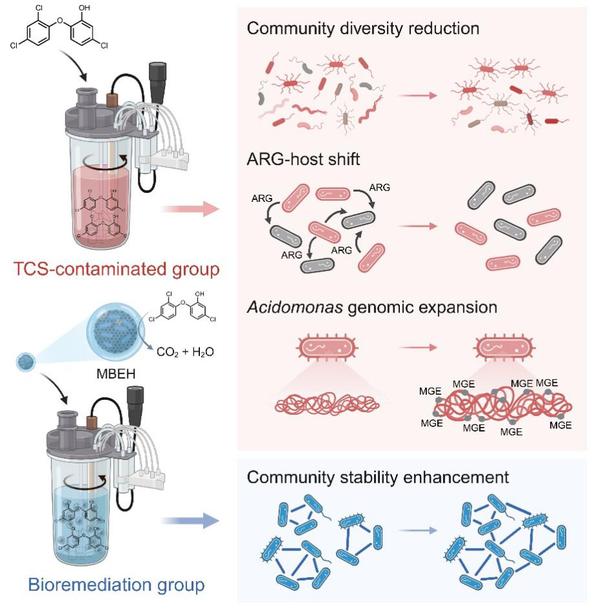
The widespread presence of emerging contaminants, such as triclosan (TCS), in environmental systems raises significant concerns regarding their ecological risks, particularly the propagation of antibiotic resistance genes (ARGs). In this study, sequencing batch reactors (SBRs) were exposed to a TCS concentration gradient to simulate the accumulation of TCS in activated sludge and to elucidate its effects on microbial community structure, ARG dissemination, and horizontal gene transfer (HGT). Using a multi-omics approach that integrated 16S rRNA amplicon sequencing, short- and long-read metagenomics, and genome-scale metabolic modeling, we demonstrated that increasing TCS concentrations progressively reduced microbial diversity and stability. At lower TCS concentrations (0–1.0 mg/L), ARG-carrying bacteria were enriched, whereas at higher concentrations (10 mg/L), TCS eliminated ARG-carrying bacteria and selected for strains rich in mobile genetic element (MGE). Notably, HGT led to genome expansion of Acidomonas methanolica (from 3.75 Mb to 7.13 Mb), disrupting the microbial interaction networks within the community. Additionally, the introduction of a triclosan-degrading hydrogel-magnetic biochar-engineered strain composite mitigated the destabilizing effects of TCS stress on the microbial community, enhanced its resilience, and facilitated TCS degradation, thus reducing associated environmental risks. Our findings highlight how gradient TCS exposure reshapes microbial communities, promotes the dominance of MGE-enriched taxa, and has profound implications for the ecological and evolutionary dynamics of microbial communities in aquatic ecosystems. This study provides novel insights into the role of emerging contaminants in the propagation of resistance and microbial adaptation.
Link:https://www.sciencedirect.com/science/article/pii/S0043135426002976