
Title: Larger habitat islands maintain more persistent mutualistic assemblages
Chen Zhu, Peng Ren, Longxiao Chang, Jordi Bascompte, Fernando Gonçalves, Bo Dalsgaard, Chuliang Song, Yuhao Zhao, Wande Li, Di Zeng, Ping Ding, Xingfeng Si
Abstract
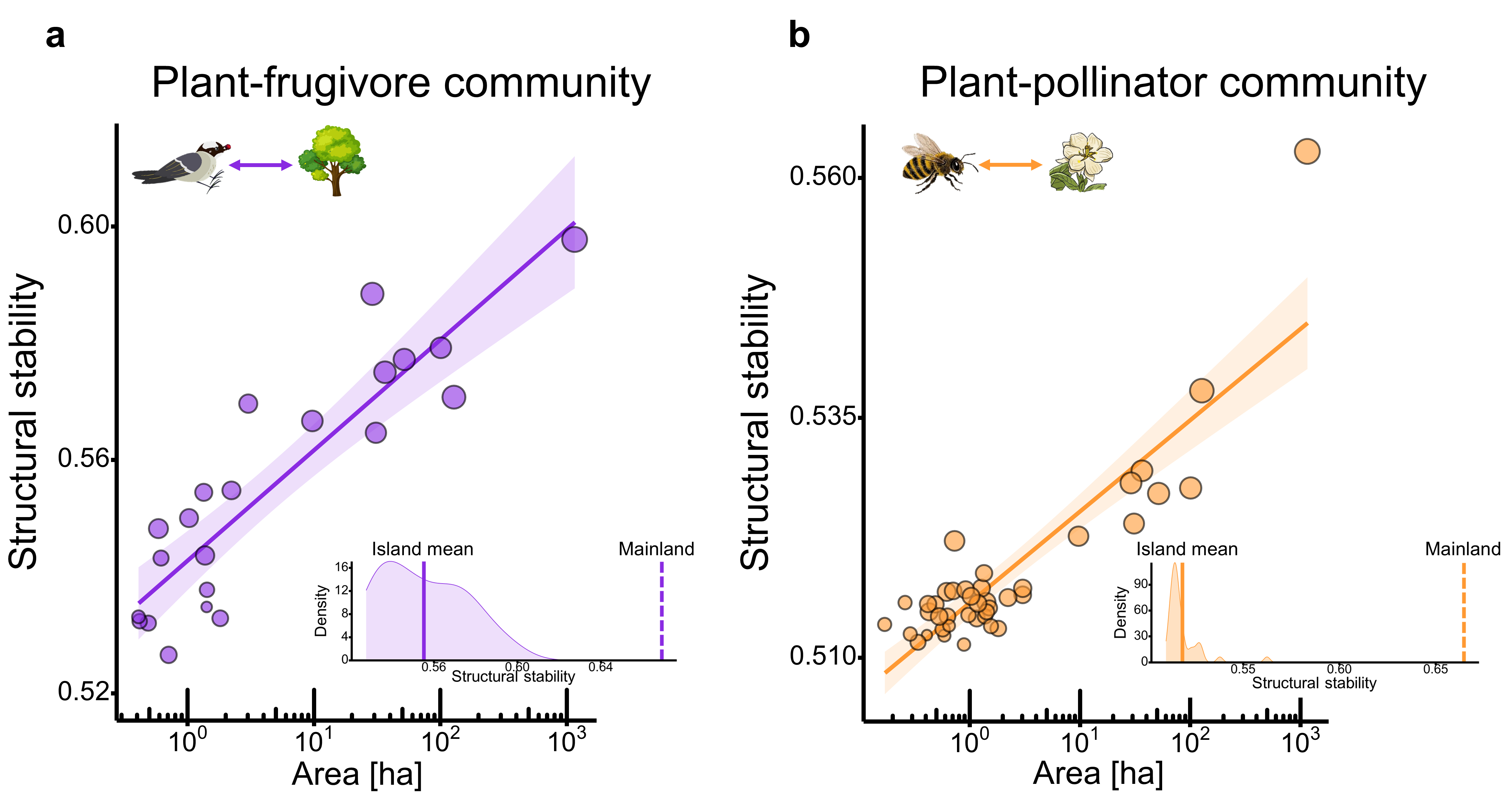
Habitat loss and fragmentation threaten biodiversity by reducing species richness and disrupting ecological interactions. But it is poorly understood how reduced habitat area and increased isolation impact community persistence, as measured by its capacity to maintain multispecies coexistence. We draw on an intensive, multi-year field study of mutualistic interactions in plant-frugivore and plant-pollinator networks across 41 islands in an insular fragmented landscape formed by dam construction in 1959. We show that the loss of island area after inundation is the primary driver that reduces the persistence of mutualistic assemblages, beyond merely reducing species richness. We further identify structural mechanisms of persistence: on larger islands, decreasing network modularity enhances persistence in both plant-frugivore and plant-pollinator communities, whereas increasing nestedness contributes to persistence only in plant-pollinator communities. These findings represent a conceptual advance in understanding the impact of habitat loss on biodiversity by showing that species loss in small habitat fragments may result from the reduced capacity of their mutualistic communities to support species coexistence, mediated by changes in network structure. We urge to include evaluations of community persistence into the design of conservation and habitat restoration strategies to more effectively mitigate the long-term impacts of habitat loss and fragmentation on biodiversity.
Link: https://www.nature.com/articles/s41467-026-77074-2